
Let's address the elephant in the room from the start.
If you’ve had a look at my homepage or my about page, you’ll have noticed I’m not South Asian. I am, in fact, a giant white bloke from Sheffield who is inexplicably good at blending into the background at weddings. But as an Indian wedding photographer based in Sheffield with more than thirty South Asian, Hindu, Sikh, Muslim, Tamil, and interfaith weddings across the UK, I know exactly what’s coming before it arrives.
I know the structure of a traditional Hindu ceremony. I know the Baraat is coming and I know where to be when it does. I know the Joota Chupai will happen fast and if I’m not watching for it I’ll miss it. I know the outfit change signals a completely different energy, and I know the evening at a Hindu wedding makes most Western receptions look like a quiet dinner party. I’ve been trusted with these days by families who care deeply about their traditions, and by couples who want a photographer who will honour every moment without getting in the way of any of them.
That’s what I do.
What makes a Hindu wedding different to photograph
A Hindu wedding is not a single event. It is a sequence of ceremonies, rituals, and celebrations that can span anywhere from one day to three, each with its own emotional register, its own cast of characters, and its own moments that cannot be replicated or recreated once they’ve passed.
For a photographer, that complexity is both the challenge and the privilege.
Most Western weddings follow a broadly predictable structure. Ceremony, drinks, meal, speeches, dancing. A Hindu wedding operates on a completely different rhythm. The day might begin miles away at the groom’s family home, move to a grand arrival procession, flow through a ceremony with seven distinct stages, pause for a wardrobe change, and then transform into an evening celebration that has more energy at midnight than most weddings have at any point.
If you don’t know what’s coming, you can’t be in the right place when it happens.
What an Indian Wedding Photographer in Sheffield Needs to Know
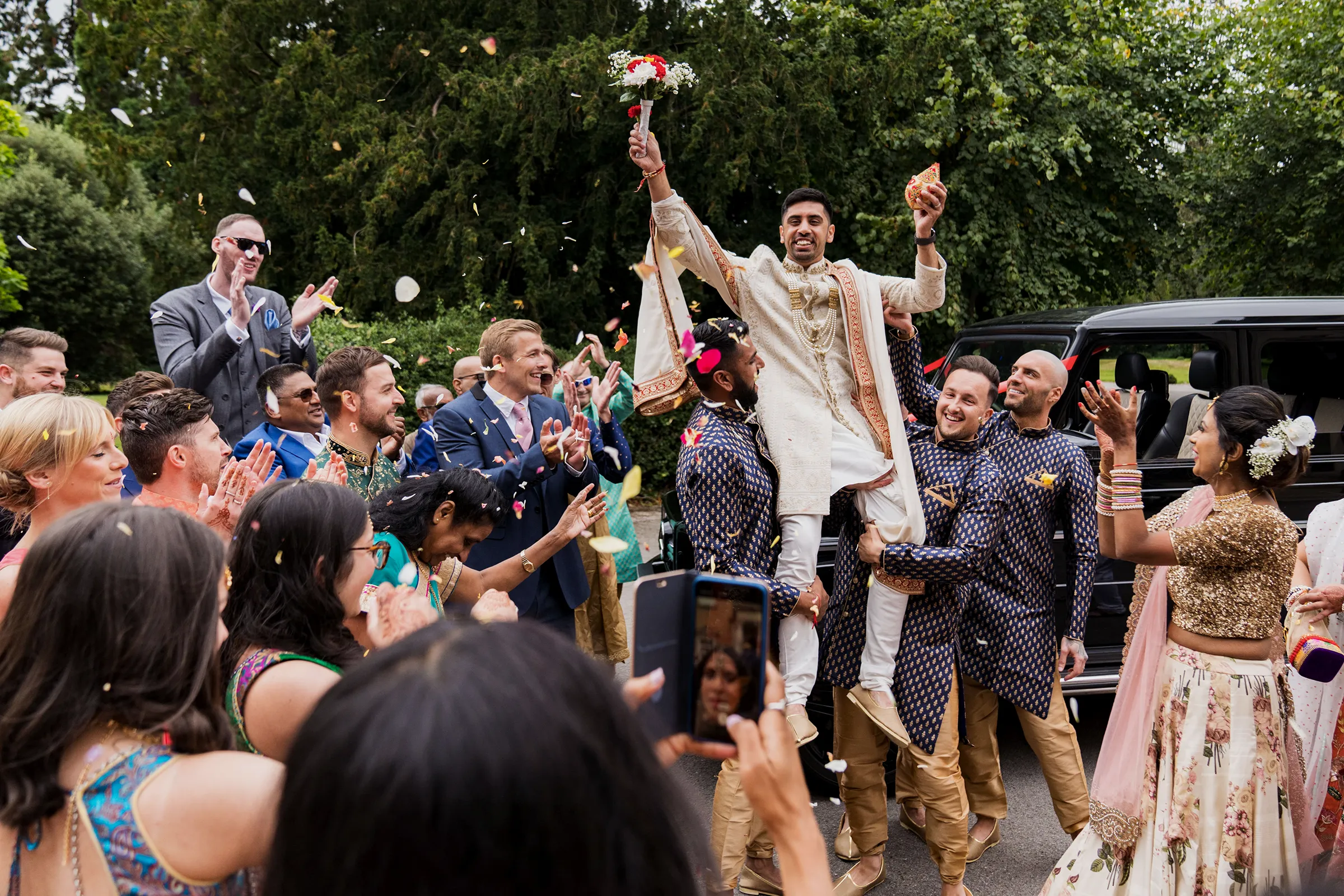
The Baraat is where the day announces itself. The groom arrives in celebration, surrounded by family and friends dancing to the dhol. It is loud, colourful, joyful, and it moves fast. The moment the bride’s family comes forward to greet them is one of the most photographically rich moments of the entire day, and it lasts seconds.
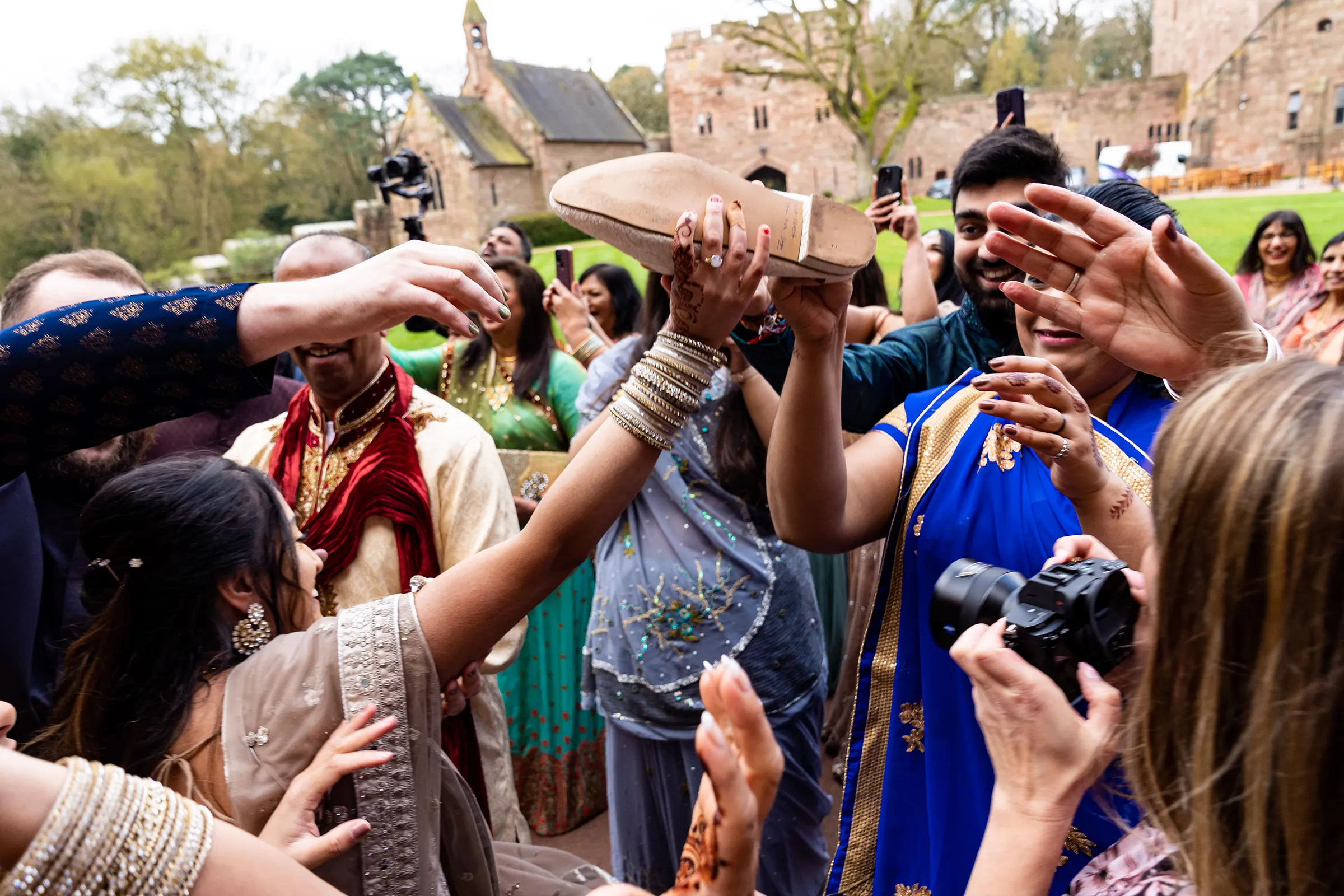
The Joota Chupai is one of my favourite moments of the entire day. The bride’s female relatives steal the groom’s shoes while he is occupied with the ceremony, and he has to negotiate, beg, and bargain to get them back. It is a brilliant piece of theatre, full of genuine laughter and completely unscripted chaos between two families who are joyfully colliding for the first time. It is also over very quickly if you don’t know to watch for it.
Then there is the Vidai.
If you want to see a stern, composed, seemingly unflappable father completely fall apart, watch him say goodbye to his daughter at the end of the ceremony.
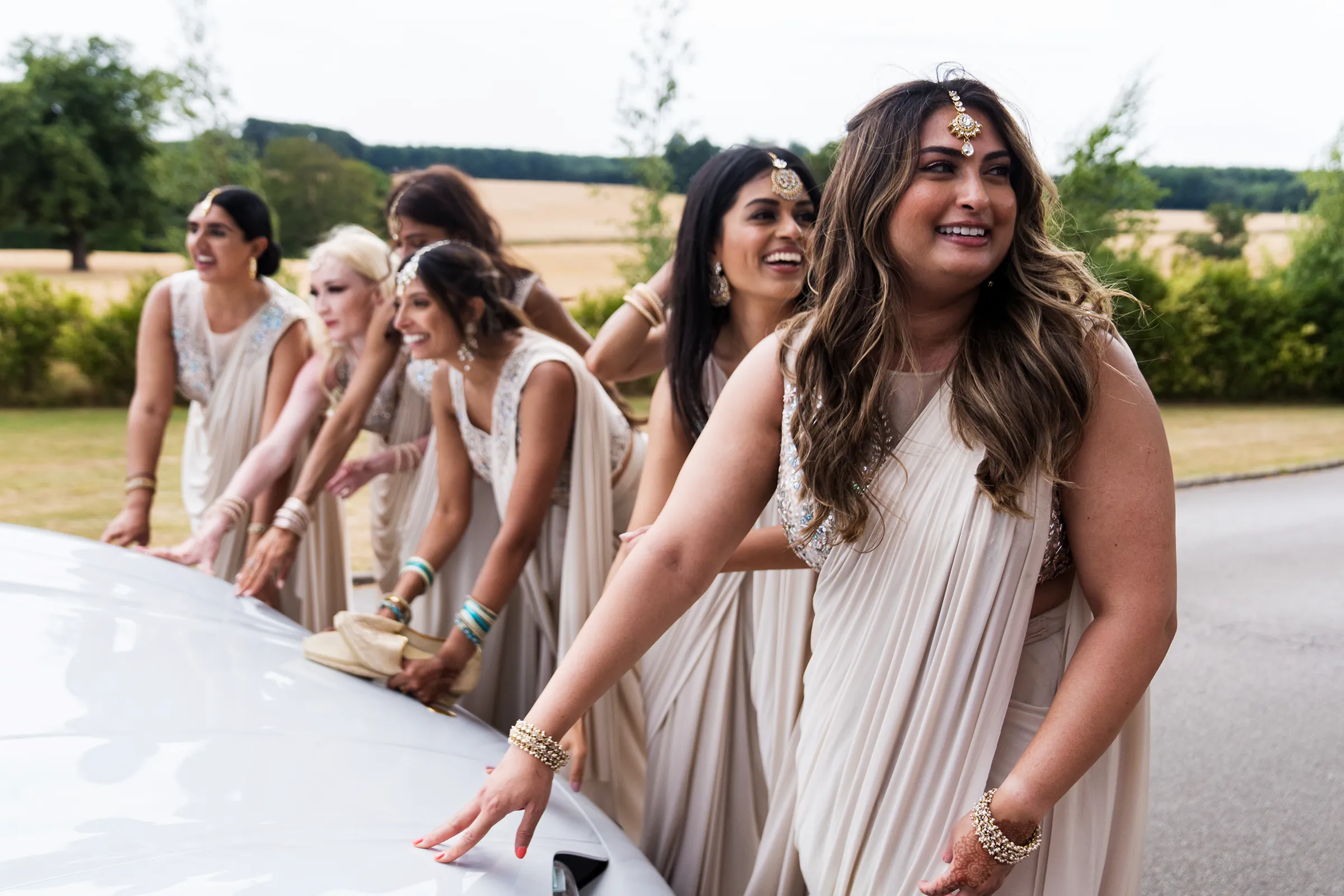
The Vidai is the bride’s departure from her family home, or from the ceremony venue, as she leaves to begin her life as a wife. There is a coconut placed under the wheel of the car. Her sisters and cousins try to hold the car back, a last playful act of keeping her close. And then her father hugs her, and whatever composure he has held together for the entire day simply goes.
I have never photographed a Vidai where the father didn’t cry. I have never photographed one where I didn’t feel the weight of it either.
It is one of the most human moments I witness as a photographer, at any wedding, of any tradition. The joy and the grief sitting right next to each other, completely inseparable.
And yes, she usually comes back an hour later for the outfit change and the evening reception. That doesn’t make it any less real.
The 7 steps of a Hindu wedding
Click the different headings below for a bit of info
1. Baraat - The Groom's Arrival
The Baraat is where the day announces itself and it does so loudly. The groom arrives surrounded by his family and friends, dancing to the dhol in a procession that is pure, uninhibited joy. It is colourful, it is loud, and it moves fast. The moment the bride's family comes forward to greet them is one of the most photographically rich moments of the entire day. I make sure I can see both families at once when it happens.
2. Ponhkhana - The Groom's welcome
The bride's mother welcomes the groom to the Mandap in a moment that is quieter than the Baraat but no less significant. After the noise and energy of the arrival procession, this is the first intimate exchange between the two families. The expressions in that moment, relief, pride, nervousness, joy, are worth watching for.
3. Ganesh Pooja - The first prayer
The ceremony begins with a prayer to Lord Ganesh, the remover of obstacles, asking for his blessing on the marriage ahead. It sets the tone for everything that follows. As a photographer this is where I settle in, read the room, and identify the family members whose faces I want to be watching throughout the ceremony.
4. Madhuparka - Offering of Milk and Honey
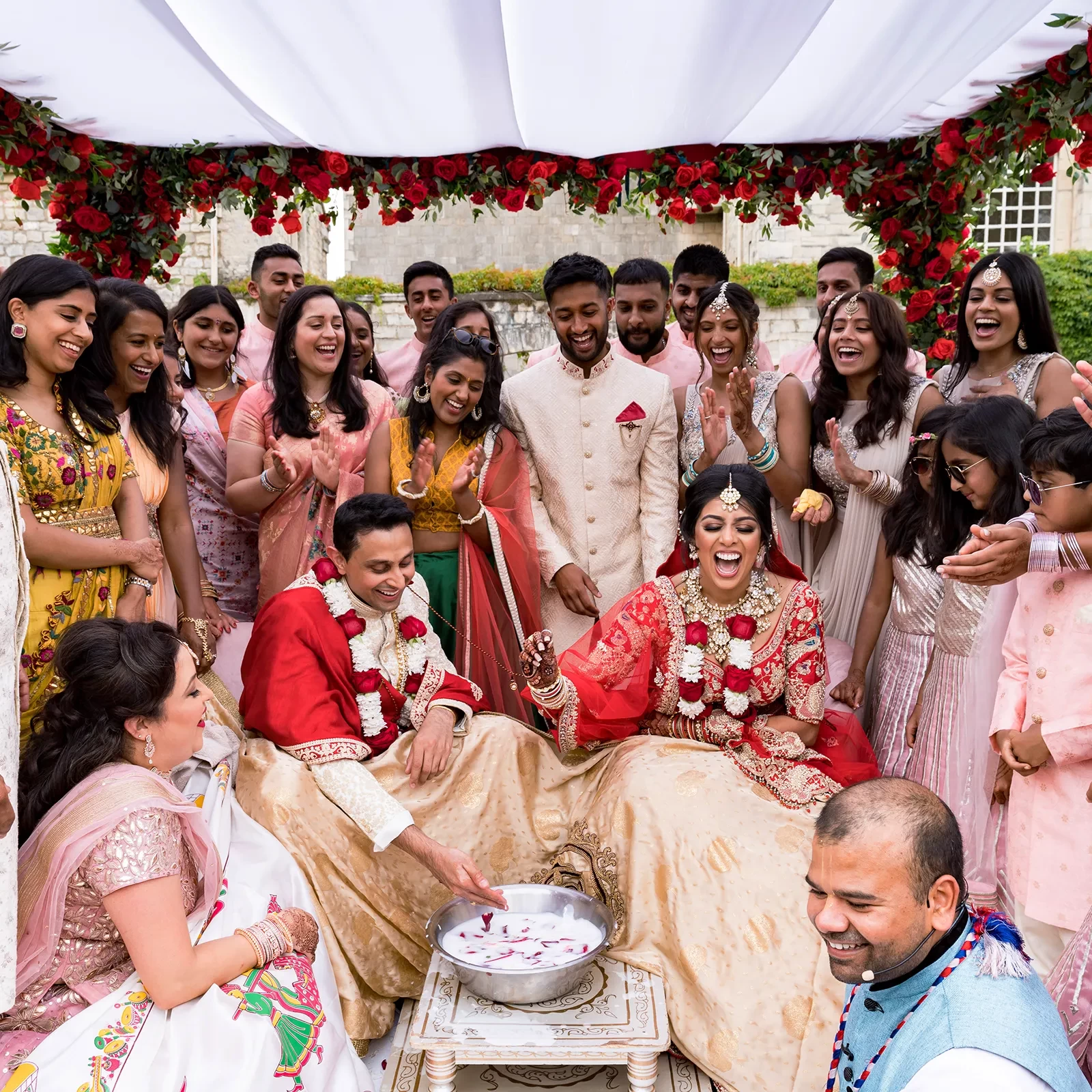
The bride's parents welcome the groom with an offering of Madhuparka, a mixture of sugar, honey, yoghurt, milk, and ghee. It is a gesture of hospitality and acceptance, the bride's family formally receiving the groom into their lives. The interaction between the groom and his future in-laws at this moment is always worth photographing closely.
5. Kanya Agaman - Bride's arrival
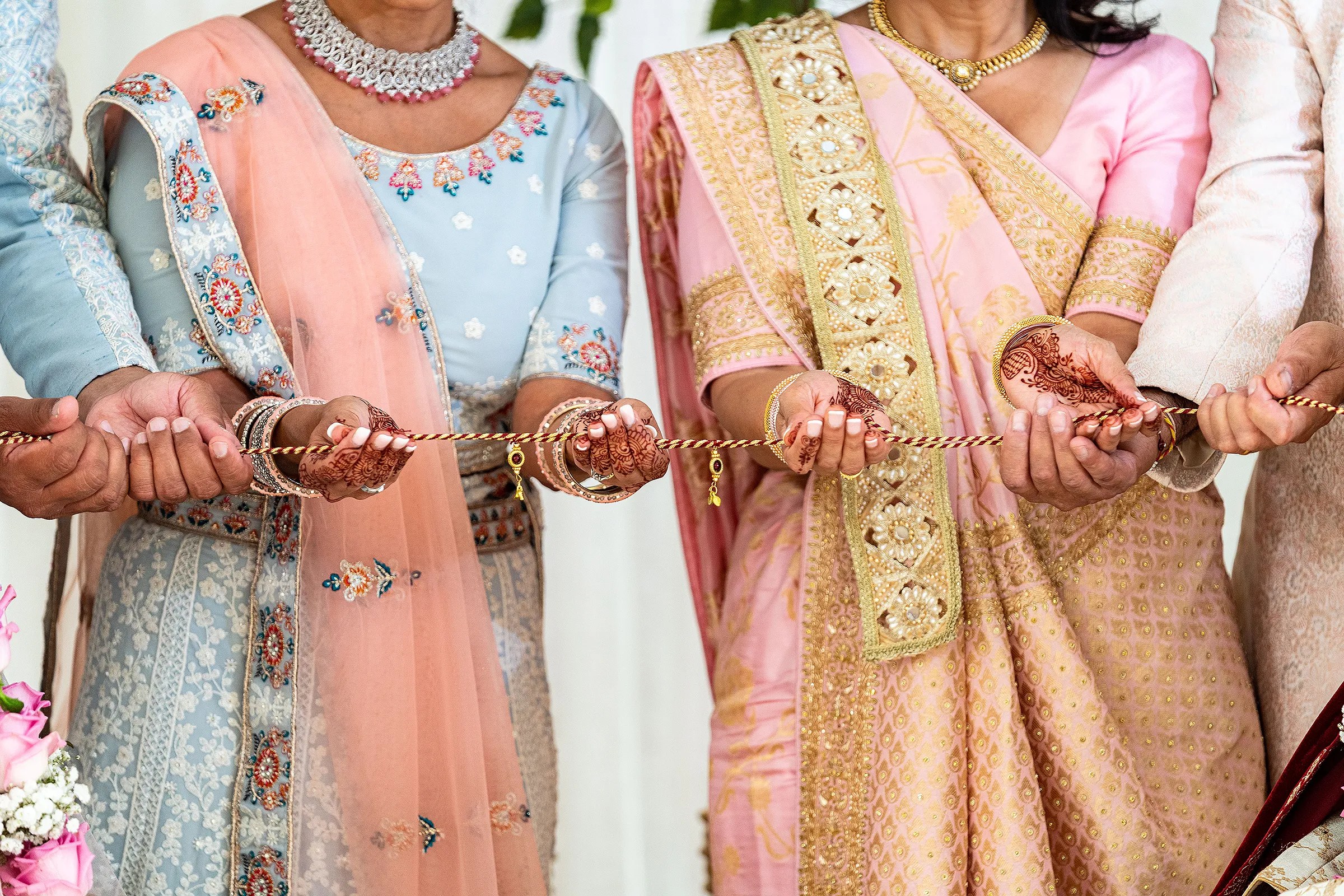
The bride is escorted to the Mandap by her maternal uncles, her mamas, while a shawl is held between her and the groom so he cannot see her until she arrives beneath the Mandap. The anticipation in the room at this point is palpable. The groom's face when the shawl is lowered is one of the moments I am always positioned to catch.
6. Jai Mala - Exchanging Garlands
The bride and groom exchange floral garlands in a moment that is often more playful than people expect. Families frequently try to lift the groom up to make it harder for the bride to place her garland around his neck. The laughter and chaos that follows is completely genuine and completely unscripted. I love this moment.
7. Kanya Daan - The giving away of the Bride.
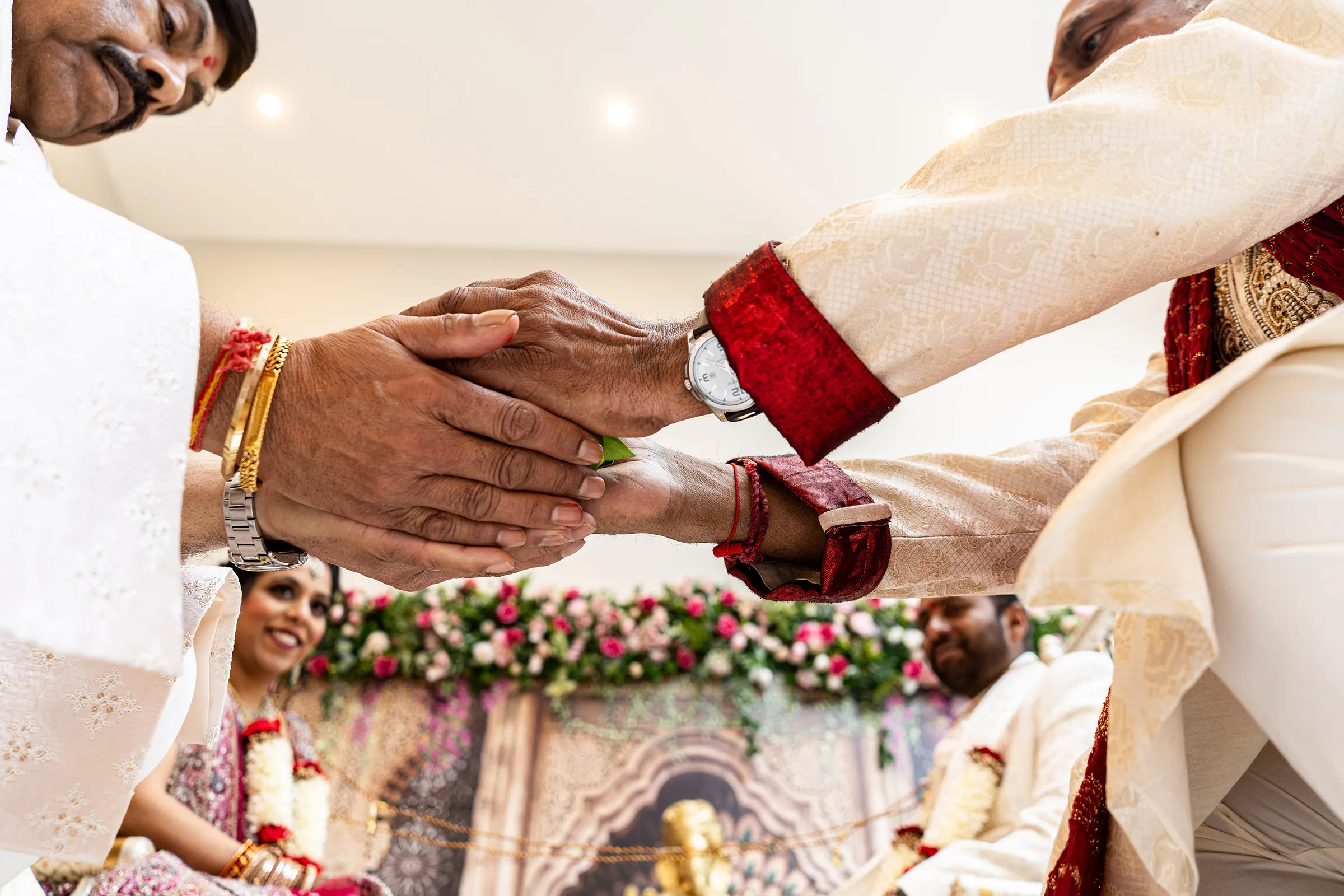
The bride's parents place their daughter's palm into the groom's palm in one of the most emotionally significant moments of the entire ceremony. The Kanya Daan is the formal giving away of the bride, and the weight of it is felt by everyone in the room. I have never photographed a Kanya Daan where the bride's father didn't struggle to hold himself together. I always make sure I can see his face.
The Venues I've worked at
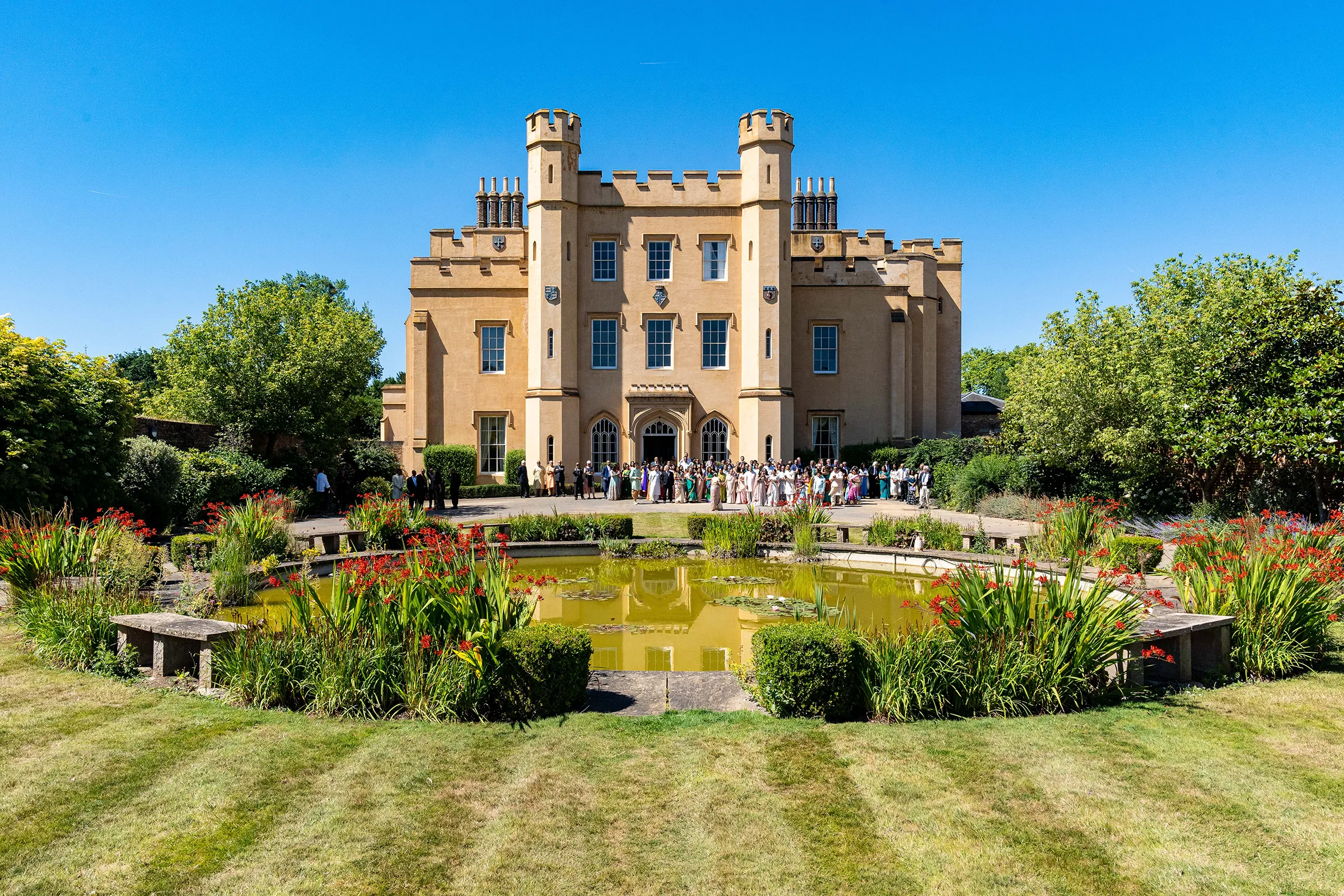
Hindu weddings in the UK are often held at venues chosen for their scale, their grandeur, and their ability to accommodate large and extended families. I’ve had the privilege of working at some of the finest in the country.
In the North and Midlands I’ve shot at Kelham Hall in Newark, Whitley Hall in Sheffield, Hazlewood Castle in Yorkshire, The Pavilions in Harrogate, Nunsmere Hall and Wrenbury Hall in Cheshire, and Hagley Hall in Worcestershire. Further afield I’ve worked at Grantley Hall in North Yorkshire, Sezincote Manor in the Cotswolds, Ditton Manor in Buckinghamshire, North Mymms Park in Hertfordshire, Bourton Hall in Rugby, Froyle Park in Hampshire, and Cadbury House in Bristol.
I’ve also shot Hindu weddings at more intimate and unconventional venues, including a beautiful private garden ceremony in Leicester.
Each venue has its own light, its own logistics, and its own challenges. Knowing a venue before you arrive makes a difference. Knowing what to photograph regardless of the venue makes more of one.
The couples who trusted me with their day.
Every wedding I shoot is built on trust. That is true of every couple I work with, but it carries particular weight when a family is inviting someone outside their culture to document one of the most significant days in their tradition.
Divya and Shy chose me for their Hindu wedding at Whitley Hall in Sheffield. Knowing they had a local photographer who understood the day, who wouldn’t need to be guided through every ritual, and who would be in the right place without being asked, mattered to them. The photographs from that day are some of the work I’m most proud of.
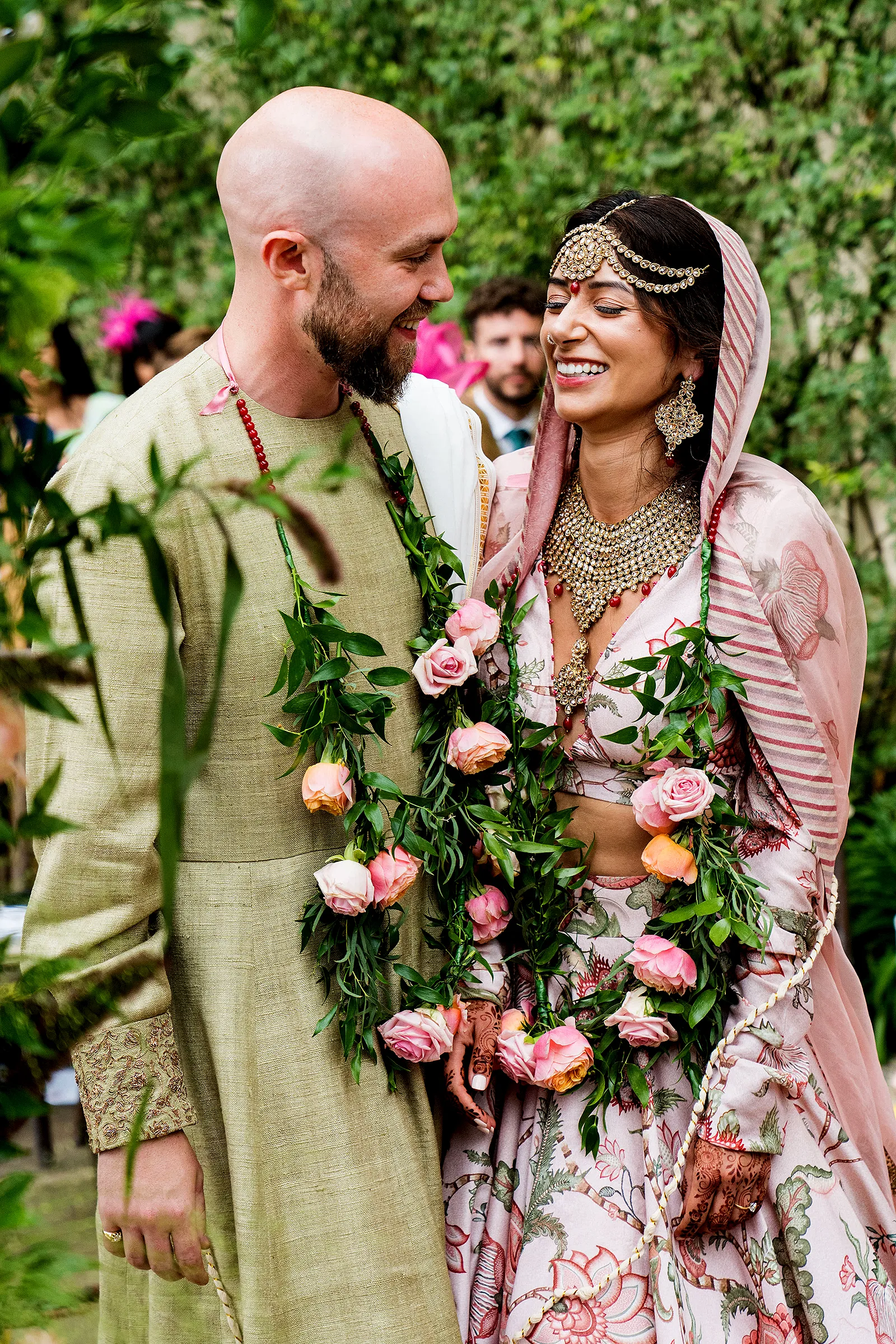
Paul and Bhav celebrated with a civil ceremony followed by a Hindu blessing at Tey Brook Farm in Essex, a beautiful outdoor woodland setting that gave the day a completely different feel to the grand ballroom weddings I more often shoot. The intimacy of that setting, combined with the colour and ceremony of a Hindu blessing, produced some of the most quietly stunning images I’ve made.
I’ve also had the privilege of photographing weddings that sit at the intersection of cultures and traditions. A Hindu and Jewish interfaith wedding at Froyle Park in Hampshire required understanding two sets of traditions, two families with entirely different expectations, and finding the visual thread that connected them. Getting that right required preparation, conversation, and genuine respect for both sides of the day.
Whatever your wedding looks like, however it combines traditions, families, or faiths, I will do the work to understand it before I arrive.
What I need from you before the day
The best Hindu wedding photography starts weeks before the wedding itself.
I will always want to have a proper conversation about your day in advance. Not a brief call to confirm logistics, a real conversation about your family, your traditions, the moments that matter most to you, and anything specific to your ceremony that I should know about. Every Hindu wedding is different. Regional traditions vary, family customs vary, and the things that will make your parents cry are unique to your family.
Tell me about your day. The more I know, the better I can serve it.
A note on pricing
A single day Hindu wedding starts from £2,000. Each additional day, whether that’s a Mehndi night, a Garba, or a civil ceremony on a separate date, is £1,000. No complicated packages, no hidden charges, no surprises. If your celebration spans multiple days and you want to talk through what coverage makes sense for your budget, just ask. I’d rather have that conversation early than have you guessing.
Let's talk about your Hindu wedding
If you’ve read enough to know you want to talk, brilliant. If you’re still not sure whether I’m the right fit, that’s fine too. Tell me about your plans and I’ll give you an honest answer either way.
To help me respond properly, it’s worth including your wedding date(s) and venue(s) if you have them, a rough idea of what you’re looking for from your photography, and anything that feels important that you want me to understand.
The more you tell me, the more useful I can be from the first message.
I’m also on WhatsApp if that’s easier, I tend to respond faster there than anywhere else.
If you’d like to see more before getting in touch, take a look at the portfolio or find out more about packages and pricing. And if you’ve already made up your mind, brilliant. Get in touch.